Recently, the Innovation Team of Novel Water-saving Materials and Agricultural Film Pollution Control at the Institute of Environment and Sustainable Development in Agriculture, Chinese Academy of Agricultural Sciences, published significant research findings in Journal of Hazardous Materials, focusing on changes in the properties of plastic film microplastics (MPs) after they enter the human digestive system.
Plastic films are widely used in agriculture and food packaging, and MPs generated following the aging of these materials may enter the bodies of animals through the food chain. However, studies systematically comparing the surface evolution characteristics of MPs from traditional and biodegradable plastics in digestive fluids are still blank.
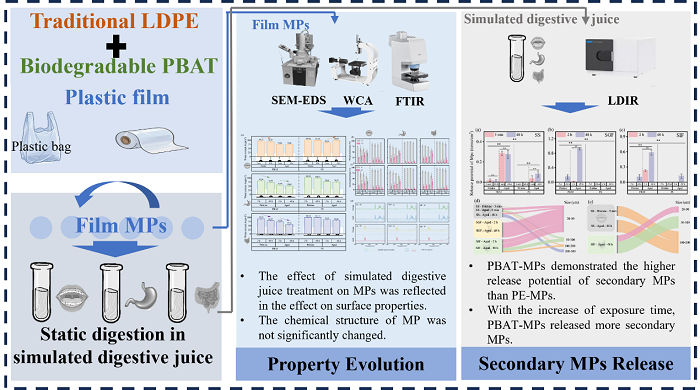
By establishing a static in vitro simulated digestive system, the study compared the evolution of properties of traditional polyethylene (PE) and biodegradable poly butylene adipate-co-terephthalate (PBAT) films in three simulated digestive fluids, namely saliva, gastric and intestinal fluids. Results indicated that none of the simulated digestive fluids visibly altered the primary chemical structure of the MPs, but they significantly affected their surface properties. Among them, PE MPs exhibited high stability in digestive fluids, with relatively limited changes, and persisted in the digestive environment. In contrast, PBAT MPs showed more notable surface responses, a stronger hydrophilization tendency and more active surface evolution characteristics, as well as more pronounced responses to environmental preaging. After entering complex biological environments, PBAT film MPs exhibited more active surface response characteristics and a higher potential for degradation. The study provides a reference for the environmental impact assessment and green application of biodegradable materials.
This research was supported by the National key Laboratory for Efficient Utilization of Agricultural Water Resources, the Key Laboratory of Prevention and Control of Residual Pollution in Agricultural Film under the Ministry of Agriculture and Rural Affairs, and the Agricultural Science and Technology Innovation Program (ASTIP) of the Chinese Academy of Agricultural Sciences.
Linkage: https://doi.org/10.1016/j.jhazmat.2025.141003
