Recently, the Innovation Team of Novel Water-saving Materials and Agricultural Film Pollution Control at the Institute of Environment and Sustainable Development in Agriculture, Chinese Academy of Agricultural Sciences, elucidated the process in which multifunctional light-converting greenhouse films improved both tomato yield and fruit quality by optimizing the light-temperature microenvironment in solar greenhouses. The related findings have been published in Scientia Horticulturae.
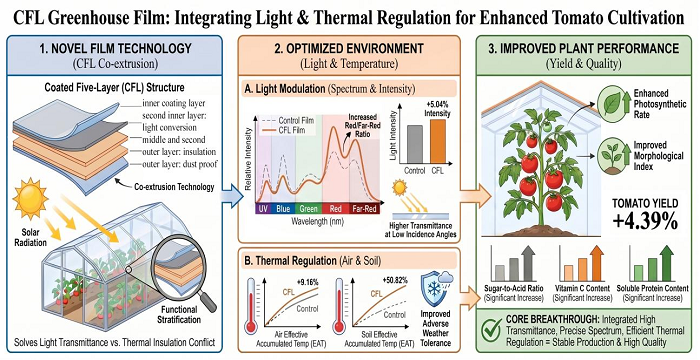
Conventional single-functional agricultural greenhouse films have difficulty in balancing light transmittance and thermal insulation, and therefore cannot address the industry bottleneck of meeting the light and temperature requirements of solanaceous crops.
The study found that compared with conventional greenhouse films, a novel light-converting greenhouse film could optimize spectral composition and increase light intensity by over 5.04%, while maintaining stable light transmittance under low incidence angles. It also significantly enhanced accumulated temperature and improved stress tolerance under low-temperature and low-light conditions. Following the application of the novel greenhouse film, tomato yield increased by 4.39%, with simultaneous improvements in nutrient indicators such as sugar-to-acid ratio, vitamin C, and soluble protein content. The study confirmed for the first time that accumulated soil temperature is the core driving factor of tomato plant morphology and root development, and that an appropriate light spectrum can harmonize plant growth, photosynthetic performance and fruit-setting rates. It established an integrated regulation pathway from optimal light and temperatures, strong stems and roots, to improved fruit quality and yield. These findings provide support for formulation optimization, process upgrading and commercialization of light-converting films designed exclusively for solar greenhouses.
This research was funded by the National Key Research and Development Program of China, the MARA Key Laboratory of Prevention and Control of Residual Pollution in Agricultural Film, and the Agricultural Science and Technology Innovation Program (ASTIP).
Linkage: https://doi.org/10.1016/j.scienta.2026.114887
