On April 9, the launch meeting for the 2026 scientific task "Mechanisms of Climate Change-Induced Decline in Wheat Nutritional Quality and Adaptation Strategies" - a key project under the Basic Science Research Center of the Agricultural Science and Technology Innovation Program (ASTIP) of the Chinese Academy of Agricultural Sciences (CAAS) - was held in Beijing. The project is led by the Institute of Environment and Sustainable Development in Agriculture (IEDA), CAAS. Officials from the Department of Research Management of CAAS and IEDA Director General Yi Keke attended the meeting and gave pep talks. The meeting was chaired by IEDA Deputy Director General Yao Zonglu.
During the meeting, Prof. Ma Xin, head of the project, presented the project's overall implementation plan, and outlined a cross-scale research approach spanning global, farmland and molecular scales, with a focus on the core problem of declining quality of nutrients in wheat, including protein, due to rising atmospheric CO₂ concentrations. He also clarified three major research tasks: analyzing the patterns of decline, revealing mechanisms of carbon and nitrogen metabolic imbalance, as well as identifying key genes and developing adaptive materials. Then he systematically explained the division of work in the team, research foundations and expected outcomes. Sub-task leaders reported their respective specific research plans, technical approaches and evaluation indicators for global wheat quality trend forecasting, precise regulation of carbon and nitrogen metabolism, and molecular mechanisms and variety screening.
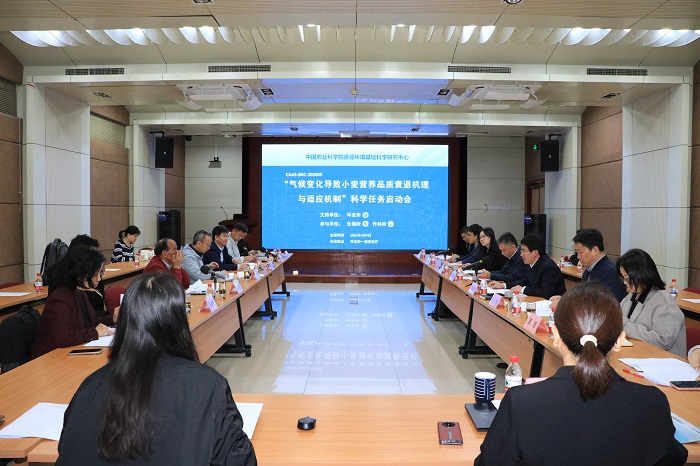
The meeting established an expert advisory group comprising authoritative experts in climate change, crop genetics and bioinformatics, with Researcher Wu Shaohong from the Institute of Geographic Sciences and Natural Resources Research, Chinese Academy of Sciences, appointed as the group leader. The expert advisory group offered practical recommendations concerning material selection, experimental design, indicator optimization and focus of the outcomes. It also emphasized the need to further focus on core scientific challenges, refine experimental conditions control, and highlight originality and application value to ensure desired results from the research. The project team deliberated over the advice, optimized the implementation path, and refined the division of work to see that all responsibilities are fulfilled, laying a solid foundation for the high-quality implementation of the project.
Addressing China's major demands such as national food security and public nutrition and health, the project focuses on prominent wheat problems caused by climate change and rising atmospheric CO₂ concentrations, including decreased protein content, reduced zinc and iron levels, and quality decline. It prioritizes analysis of the molecular mechanisms underlying quality decline and carbon and nitrogen metabolic imbalance, establishment of adaptation models and regional strategies, and R&D of key technologies such as precise physiological regulation and adaptive materials. The project will identify climate change-induced quality decline hotspots globally, establish a multi-tired adaptive technology system, and make breakthroughs across the entire chain to maintain wheat nutritional quality while enhancing wheat production capacity under climate stress, thereby addressing the risk of quality decline associated with climate change.
More than 20 participants attended the meeting, including officials from the Department of Research Management of CAAS and IEDA, members of the expert advisory group, and representatives from organizations undertaking the project.
