Recently, the Agricultural Emerging Contaminants and Environmental Health Risk Prevention and Control Team at the Institute of Environment and Sustainable Development in Agriculture, Chinese Academy of Agricultural Sciences, revealed the mechanism by which boron-nitrogen (B–N) conjugated doping disrupts the extended π-conjugated system of biochar to promote the selective activation of peroxymonosulfate (PMS) for singlet oxygen (1O2), thereby achieving the rapid degradation of sulfamethoxazole, providing a novel strategy to tune the π-conjugated structure of biochar for high-performance carbon catalysts in advanced oxidation processes. The findings have been published in Applied Catalysis B: Environment and Energy.
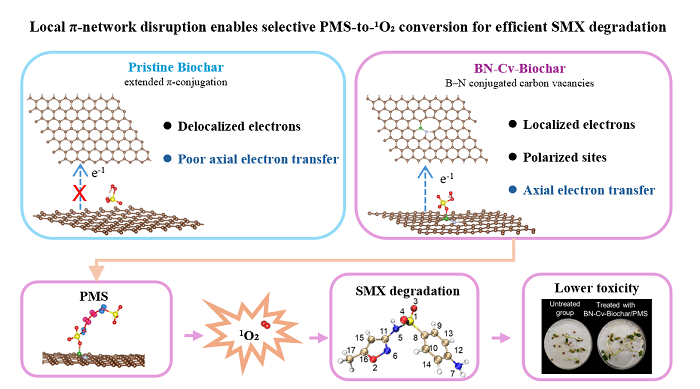
Selective activation of peroxymonosulfate (PMS) to produce singlet oxygen (1O2) is desirable for efficient water purification. Graphitized biochar is a promising catalyst, but its extended π-conjugated structure favors in-plane charge delocalization and hinders axial electron transfer, leading to low 1O2 selectivity.
The study demonstrated that B–N doping breaks the extended π-conjugation, creating polarized active sites and localized electrons that strengthen axial electron transfer and selective PMS adsorption. The degradation rate constant of sulfamethoxazole (SMX) of BN-Cv-Biochar is 1.68 and 4.45 times higher than that of pristine (Biochar) and nitrogen-doped carbon-vacancy biochar (N-Cv-Biochar), respectively. Experimental and theoretical results reveal that B–N sites coupled with carbon vacancies optimize the electronic environment, reduce the energy barrier for 1O2 generation, and preferentially promote 1O2-dominated PMS activation. This study provides a new strategy for constructing high-performance carbon-based catalysts by tuning the π-conjugated structure of biochar, and offers technical support for the remediation of sulfonamide antibiotics and other emerging contaminants in water.
This work was financially supported by National Natural Science Foundation, and the Agricultural Science and Technology Innovation Program of China.
The original article is available at: https://www.sciencedirect.com/science/article/abs/pii/S0926337326009409
