Recently, the Innovation Team of Novel Water-saving Materials and Agricultural Film Pollution Control at the Institute of Environment and Sustainable Development in Agriculture, Chinese Academy of Agricultural Sciences, has pioneered the application of biodegradable film mulching cultivation in a rice-growing region of Northeast China. Addressing the core challenge of maintaining high and stable yields while enhancing water use efficiency in dry direct-seeded rice production under film mulching, the team elucidated the mechanisms whereby root trait improvements induced by biodegradable film mulching influence grain yield. These findings have been published in the Journal of Integrative Agriculture.
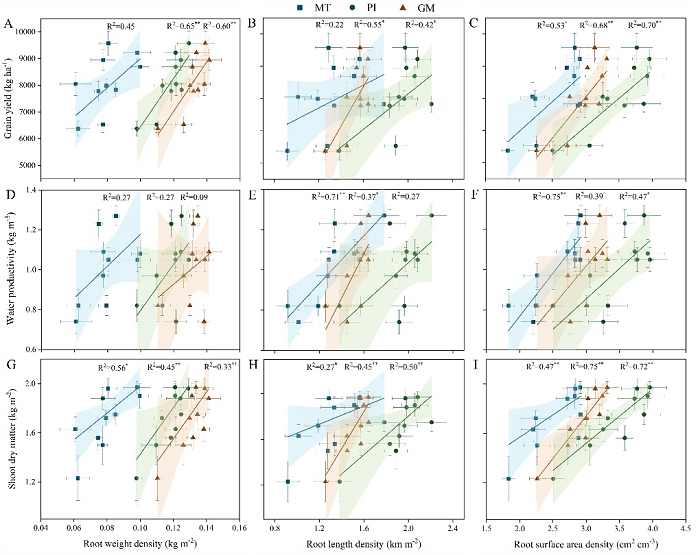
Fig.1 Grain yield, water productivity and shoot dry matter in relation to root characteristics across different rice production systems
As illustrated in Fig. 1 (Grain yield, water productivity, and shoot dry matter in relation to root characteristics across different rice production systems), the study demonstrated that biodegradable mulch film significantly enhanced soil temperature regulation and moisture retention during early rice growth stages, thereby optimizing the root-zone hydrothermal microenvironment and stimulating root system development and function (including increases in root length, dry weight, and surface area, particularly at the panicle initiation stage). Comprehensive analysis revealed that key root developmental metrics exhibited highly significant positive correlations with grain yield, water productivity, and shoot dry matter, achieving synergistic improvements in water conservation, yield enhancement, and resource efficiency.
The study has opened up a new path for the establishment of a sustainable rice production model that is water-saving, cost-efficient, green and high-yield, fully demonstrating the immense application potential of biodegradable mulch films in driving the green transformation and sustainable development of agriculture. The work provides critical practical guidance for enhancing water-use efficiency, boosting production capacity, and building climate-resilient agricultural systems in Northeast China’s rice areas, while concurrently offering vital scientific and technological support to address global food security challenges and climate change pressures.
This research was supported by the National key Laboratory for Efficient Utilization of Agricultural Water Resources, the Key Laboratory of Prevention and Control of Residual Pollution in Agricultural Film under the Ministry of Agriculture and Rural Affairs, and the Agricultural Science and Technology Innovation Program (ASTIP) of the Chinese Academy of Agricultural Sciences.
Linkage: https://doi.org/10.1016/j.jia.2025.07.015
