Recently, the Innovation Team of Climate Change and Carbon Sequestration and Mitigation at the Institute of Environment and Sustainable Development in Agriculture, Chinese Academy of Agricultural Sciences, made significant progress in the research on greenhouse gas (GHG) emissions in alpine meadows on the Qinghai-Xizang Plateau. The related findings have been published in the internationally renowned journal Agriculture, Ecosystems & Environment.
In nitrogen-limited ecosystems, plants and microbes compete over mineralized nitrogen (N) utilization. Microbial N use efficiency (microbial NUE) is both a key factor regulating soil gross N mineralization, nitrification-denitrification and nitrous oxide (N2O) emissions, and the result of trade-offs in microbial biomass accumulation through organic-mineralized N utilization. Plant-microbe competition for mineralized N regulates N2O emissions by affecting microbial NUE. Climate change can alter plant community growth patterns, and affect plant demand for mineralized N. Therefore, a cascade regulation pathway exists for N2O emissions in a changing climate: "plant growth patterns→plant-microbe competition for mineralized N→microbial NUE".
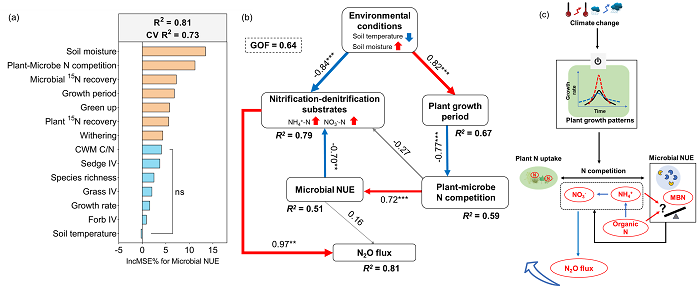
Ranking of variables affecting microbial NUE by importance, analysis of the path by which climate change impacts N2O, and conceptual diagram of the relevant mechanism
The team conducted field observations and an in-situ 15N labelling experiment on a long-term climate change simulation experimental platform of the Field Scientific Observation and Research Station for Agricultural Environment, Nagqu, Ministry of Agriculture and Rural Affairs. The findings indicate that changes in plant community growth patterns act as a "key power switch" regulating microbial NUE and N2O emissions under climate change. The research linked up for the first time plant phenology and plant-microbe N utilization interplay to N2O emissions. It underlined the critical mediating role of plant communities in N2O emissions under climate change, providing theoretical insights into the research on plant-soil feedback mechanisms in a changing climate. The findings have important implications for the adaptive management of grassland ecosystems and GHG emissions reduction on the Qinghai-Xizang Plateau.
Linkage: https://doi.org/10.1016/j.agee.2026.110414.
