Recently, the Innovation Team of Plant Environmental Engineering of Protected Agriculture at the Institute of Environment and Sustainable Development in Agriculture, Chinese Academy of Agricultural Sciences, developed a microbial fuel cell (MFC)-based biosensor for quantifying the total organic load of hydroponic lettuce root exudates. The findings were published in the international journal Bioresource Technology.
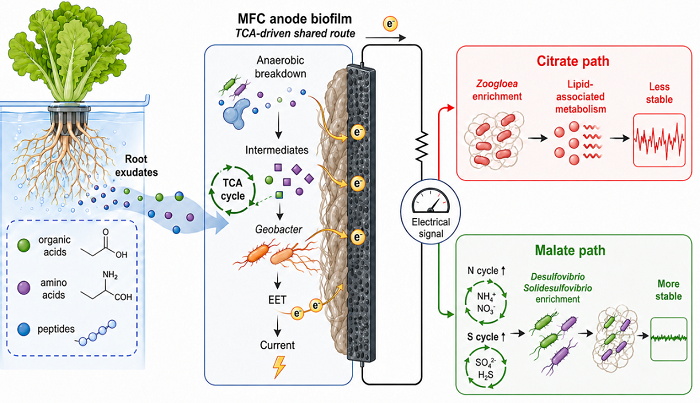
Root exudates (RE) represent an important pathway through which plants release photosynthetically fixed carbon into the root zone. Under artificial lighting, a portion of this carbon is released into the nutrient solution as RE, potentially affecting carbon use efficiency and the nutrient solution environment. However, the low concentrations and complex composition of RE make them difficult to monitor. Conventional detection methods rely on laboratory-based analyses, limiting their application for continuous monitoring in hydroponic systems.
Using electrical signals generated by microorganisms as they break down organic matter, the research team developed a bioelectrochemical sensing method to quantify RE. An adaptive acclimation strategy improved the response of MFC biosensors to complex RE mixtures. The team further validated the sensor's quantitative performance during an actual hydroponic lettuce cultivation cycle. This study provides a new approach to monitoring root-derived organic matter and offers potential applications in understanding plant carbon allocation, optimizing supplemental lighting, and improving nutrient solution management in greenhouses.
This work was supported by the Beijing Natural Science Foundation and the Agricultural Science and Technology Innovation Program of the Chinese Academy of Agricultural Sciences.
Linkage: https://doi.org/10.1016/j.biortech.2026.136001
