Recently, the Research Team of Agricultural New Pollutants and Environmental Health Risk Prevention and Control at the Institute of Environment and Sustainable Development in Agriculture, Chinese Academy of Agricultural Sciences, developed a low-cost technology to improve acidic soils through mixed application of milled rice husks and nitrogen fertilizer, in collaboration with the University of Ibadan. The study was carried out through the China-Nigeria Joint Laboratory for Soil and Water Conservation and Agricultural Sustainable Development. The related findings have been published in European Journal of Agronomy.
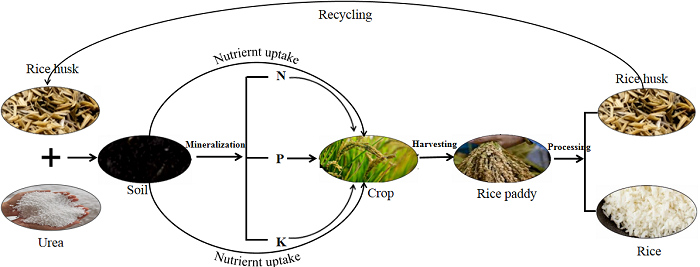
Schematic diagram showing how mixed application of milled rice husks and nitrogen fertilizer promotes nutrient cycling in rice fields
Nigeria produces millions of tonnes of rice husks annually, most of which are piled up and burned, polluting the environment; while local acidic soils constrain nutrient supply in rice fields. Focusing on minimally processed rice husks, this collaborative study systematically probed into the nutrient release dynamics and rice yield effects of these milled rice husks fortified with nitrogen fertilizer, with the aim of exploring a low-cost technical approach for improving acidic soil fertility and recycling waste rice husks.
After four years of incubation, screenhouse and field experiments, the research team screened out the optimal ratio of milled rice husk nitrogen to nitrogen fertilizer (57.15:30.87 kilograms of nitrogen/hectare). The study found that compared with conventional nitrogen application, this technology increased soil nitrogen, phosphorus and potassium levels by 23%, 20% and 68% respectively, rice yield by 32% (and 37% in the second cropping cycle), and had the highest net benefit. By eliminating processing stages such as charring, this technology resolves the dual challenges of rice husk disposal and low yields in acidic soils, providing a scalable, green option for smallholder farmers in Africa to increase rice yields.
This research was supported by the National Key Research and Development Program of China and the Agricultural Science and Technology Innovation Program of the Chinese Academy of Agricultural Sciences.
Linkage: https://doi.org/10.1016/j.eja.2026.128292
