Recently, the Innovation Team of Remediation of Degraded and Contaminated Farmland at the Institute of Environment and Sustainable Development in Agriculture, Chinese Academy of Agricultural Sciences, made new progress in research on mechanisms governing the dissemination of antibiotic resistance genes (ARGs) across the environment. The study demonstrated the pivotal role of soil landscape features in the migration and spread of ARGs in sloping croplands. The related findings have been published in the Journal of Hazardous Materials.
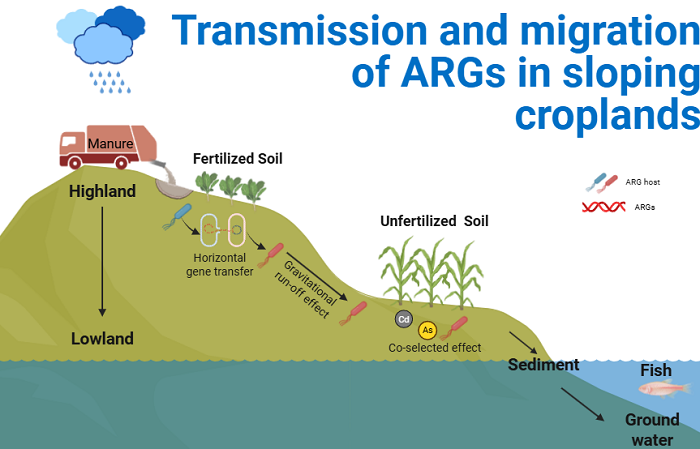
Livestock manure is a major source of ARGs in agricultural soils; however, the mechanisms governing its transmission across ecosystems in real agricultural landscapes remain unclear. Particularly in sloping cropland systems, topography, runoff and soil environments collectively influence ARG migration and diffusion.
Focusing on a typical sloping cropland in the Dongting Lake region, the study systematically examined the mechanisms underlying ARG transmission and migration under agricultural fertilization through metagenome sequencing and bacterial community analysis. The findings reveal that livestock manure application significantly increased the abundance of ARGs in soil and promoted their diffusion across different ecological media, including soil, water bodies and sediments. Horizontal gene transfer mediated by mobile genetic elements (MGEs), coupled with microbial migration driven by slope runoff, jointly facilitated ARG transmission across slope ecosystems, furthering increasing ecological risks in the region. From a landscape ecology perspective, the study revealed key mechanisms governing the migration and spread of ARGs in sloping croplands, providing new scientific insights and evidence for the prevention and control of ARG pollution in agricultural environments.
This work was financially supported by the National Natural Science Foundation of China (NSFC), the China Postdoctoral Science Foundation (CPSF), and the Agricultural Science and Technology Innovation Program (ASTIP) of the Chinese Academy of Agricultural Sciences.
Linkage: https://doi.org/10.1016/j.jhazmat.2026.141666
