Recently, the Innovation Team of Novel Water-saving Materials and Agricultural Film Pollution Control at the Institute of Environment and Sustainable Development in Agriculture, Chinese Academy of Agricultural Sciences, revealed the mechanisms governing the molecular succession and transformation of soil dissolved organic matter (DOM) under long-term polybutylene adipate-co-terephthalate (PBAT) and polyethylene (PE) microplastic disturbance. The related findings have been published in Journal of Environmental Chemical Engineering.
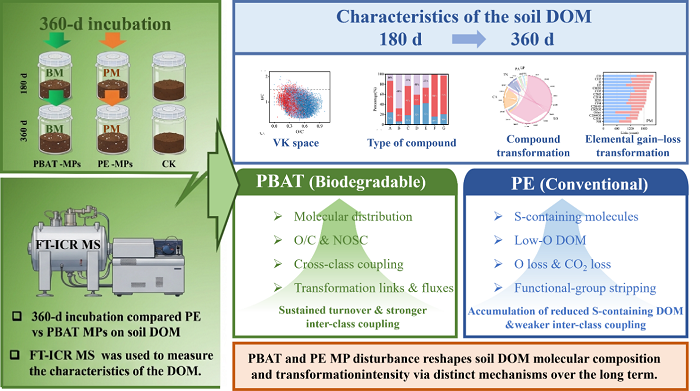
Fig.1 Experimental design and characteristics of molecular succession of soil DOM under long-term microplastic disturbance
Soil DOM is the most active fraction of soil organic matter, and provides a critical window for analyzing soil carbon turnover and molecular reassembly. However, most current studies remain limited to spectral indices and short time scales, making it difficult to resolve long-term effects of different mulch-film microplastics (MPs) on soil organic carbon pools at the molecular level. To address this problem, the research team conducted a 360-day laboratory incubation experiment using conventional (PE) and biodegradable (PBAT) mulch-film MPs. With Fourier transform ion cyclotron resonance mass spectrometry (FT-ICR MS), the team precisely identified changes in the molecular composition and potential transformation pathways of soil DOM.
The results showed that both PBAT and PE MPs significantly reshaped the molecular composition and transformation intensity of soil DOM, though via distinct mechanisms. During the 360-day incubation, PBAT MPs promoted DOM oxidation and molecular reassembly, enhancing inter-class coupling and accelerating soil carbon turnover. Conversely, PE MPs facilitated the accumulation of low-O/C, sulfur-containing, and more reduced DOM, compromising soil carbon pool stability. This study elucidated the distinct molecular-level mechanisms by which conventional non-degradable and biodegradable mulch-film MPs differentially drive soil organic matter succession and carbon pool transformation. It provides a theoretical basis for scientifically assessing the long-term ecological risks of mulch-film MPs and formulating strategies to prevent and control plastic pollution in croplands.
This study was supported by the National Natural Science Foundation of China (NSFC), the MARA Key Laboratory of Prevention and Control of Residual Pollution in Agricultural Film, and the Agricultural Science and Technology Innovation Program (ASTIP).
Linkage: https://doi.org/10.1016/j.jece.2026.123277
