Recently, the Agricultural Emerging Contaminants and Environmental Health Risk Prevention and Control Team revealed the degradation patterns of antibiotic resistance genes (ARGs) through electrochemical oxidation (EO). The study demonstrated that EO induced the fragmentation of ARGs, leading to the accumulation of deaminated sites, and identified the promoter and regulatory regions targeting ARGs. The findings were published in the Journal of Hazardous Materials.
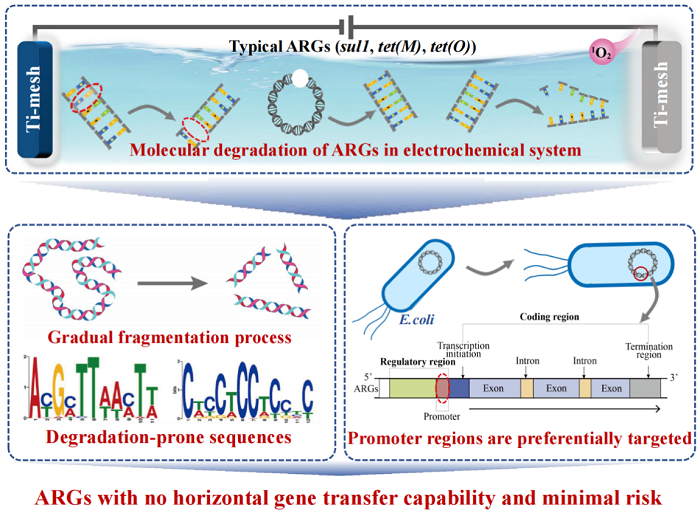
The formation mechanisms of antimicrobial resistance (AMR) and control strategies are critical global issues under the One Health framework. While current research focuses on reducing ARG abundance, the potential risks of degradation products remain unclear. This study investigated the stepwise fragmentation of typical ARGs in a titanium mesh electrode system. Results showed that electrochemical treatment significantly reduced ARG abundance with gene-specific degradation rates. The process involved DNA damage, such as deaminated site formation, and EO preferentially targeted the promoters and regulatory regions of ARGs, disrupting gene expression, especially genes related to metabolism and stress responses. The study revealed the molecular mechanisms of electrochemical treatment for AMR control and validated its effectiveness in mitigating the risk of ARG fragment spread, including horizontal gene transfer.
This study clarified how EO reduced the risk of ARG transmission and microbial resistance. It provided new insights into multi-scale ARG degradation using electrochemical systems and supported the development of related technologies for antimicrobial resistance control under the One Health framework.
This study was supported by the National Key Research and Development Program and Agricultural Science and Technology Innovation Program of China. The original article is available at: https: //www.sciencedirect.com/science/article/pii/S0304389425035599
