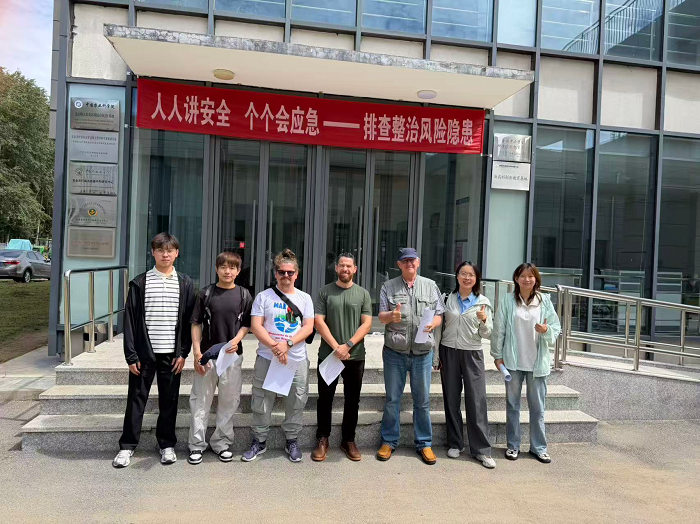
On July 14, a delegation of professors and experts from the Universidade Estadual Paulista and the Universidade de Brasília, accompanied by the Innovation Team of Smart Meteorology and Utilization of Agro-climate Resources at the Institute of Environment and Sustainable Development in Agriculture (IEDA), Chinese Academy of Agricultural Sciences, took a field trip to IEDA's agro-environment experimental base in Shunyi District, Beijing. They had in-depth discussions regarding the base's latest cutting-edge achievements in climate-resilient agriculture technology innovation, green and low-carbon agriculture, and long-term basic research.
The experts explored the largest international cooperation platform for crop response to climate change (Free-air CO2 Enrichment, FACE) in northern China, discussed strategies for regulating the climate and environmental goals related to CO2 concentration control and warming, and expressed their expectations for future international cooperation and exchanges.
At the comprehensive observation and experimental site for long-term factors of agro-environment, the delegation gained a detailed understanding of the long-term fixed-point observations the base is conducting through a "1+N" model comprising "a foundation plus extended features" to support emissions reduction, carbon sequestration, and waste recycling. The research is providing crucial data support for climate change response, emissions reduction and carbon sequestration on an ongoing basis. In the greenhouse dedicated to the research and development (R&D) of protected blueberry and grape cultivation technologies, researchers showcased the technical route for improving crop quality and productivity through light recipe regulation and precise environmental management. At the base's experimental specimen exhibition room for science popularization, visiting scholars learned about IEDA's research outcomes in the field of invasive species prevention and control, including risk assessment, monitoring, early warning and integrated prevention and control technologies. The delegation also visited the faster generation advancement phytotron, which enables accelerated breeding of multiple generations of wheat and other crops within a single year by precisely regulating environmental factors such as CO2, light, temperature, and humidity. The platform offers an intelligent solution for variety selection and quality research amidst a changing climate.
The visit has strengthened academic exchanges between China and Brazil in the fields of agro-environment and sustainable development, laying a solid foundation for scientific and technological cooperation and academic exchanges between the two sides in areas such as addressing global climate change and promoting green and sustainable development of agriculture across the region.
