Recently, the Innovation Team of Agro-meteorological Disaster Prevention and Control at the Institute of Environment and Sustainable Development in Agriculture (IEDA), Chinese Academy of Agricultural Sciences, made significant progress in research on how climate variability affects winter wheat production risks, providing a scientific basis for compound-hazard risk assessment and region-specific prevention and control for winter wheat. The findings were published in the Journal of Environmental Management.
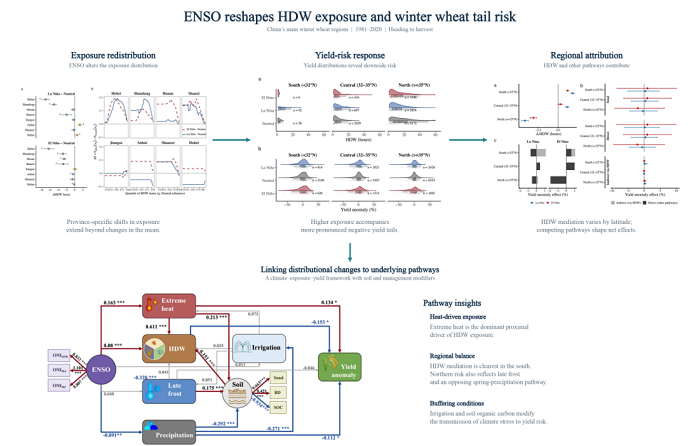
The El Niño-Southern Oscillation (ENSO) is a major driver of interannual climate variability worldwide, affecting agricultural production through anomalies in atmospheric circulations and hydrothermal conditions. Hot-dry-windy (HDW) events combine high temperature, low humidity, and strong winds, inhibiting wheat pollination and grain filling and consequently reducing wheat yield. Existing studies lack a clear understanding of the transmission mechanism by which large-scale climate variability (e.g., ENSO) causes disasters through short-lived compound stress, making it easy to underestimate low-probability but high-impact yield loss risk.
Combining 40 years of wheat yield records and hourly meteorological reanalysis data across China's main winter wheat regions, the research team established an "ENSO - HDW exposure - yield anomalies" analytical framework. The study found that ENSO exerts a threshold effect on HDW events, with high HDW exposure exacerbating yield fluctuations; its impact on yield indicates spatial asymmetry, which is primarily mediated by HDW in the south and co-regulated by late frost and spring precipitation in the north; irrigation and soil organic carbon can buffer the stress-to-loss translation. Understanding ENSO's interannual signals is expected to provide a new prediction window for winter wheat disaster early warning and risk management.
This research was funded by the Agricultural Science and Technology Innovation Program (ASTIP) of the Chinese Academy of Agricultural Sciences and the National Key Research and Development Program of China.
Linkage: https://doi.org/10.1016/j.jenvman.2026.130875
