A recent study by the Research Team of Agricultural Clean Watershed at the Institute of Environment and Sustainable Development in Agriculture, Chinese Academy of Agricultural Sciences, revealed the mechanisms regulating carbon cycling on eroded slopes in the Black Soil Region of Northeast China. The related findings have been published in Catena.
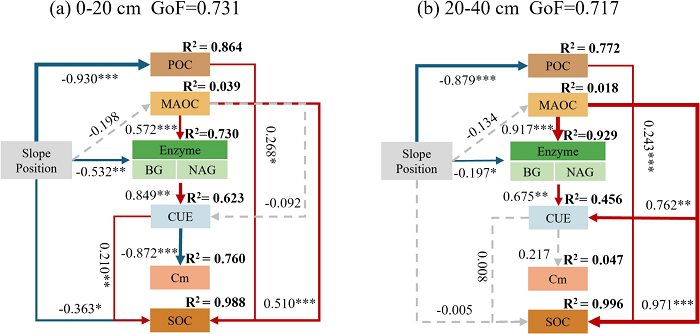
As a critical commodity grain base in China, the Black Soil Region of Northeast China has experienced a decline in black soil fertility and accelerated soil organic carbon (SOC) loss due to long-term intensive cultivation and severe slope erosion, severely threatening regional food security and the region's role as an ecological carbon sink.
Focusing on mechanisms governing the equilibrium between carbon loss and sequestration driven by erosion, the team analyzed stratified responses of microbial metabolism and mineral protection. The team measured the contents of SOC fractions, soil extracellular enzyme activities, and microbial carbon use efficiency (CUE) at different soil layers across different black soil slope positions. The results indicated that a loss of labile organic carbon in upper zones reduced CUE and exacerbated carbon loss, while stable carbon enrichment in lower zones created a local carbon sink. Additionally, the study showed a vertical stratification pattern, with microbial regulation dominating in the topsoil and mineral protection being more critical in the subsoil. This series of studies systematically elucidated for the first time the synergistic regulatory mechanisms for "physical translocation - microbial metabolism - mineral protection", and proposed technical approaches such as cross ridge cultivation, no-tillage cultivation, and carbon source supplementation on upper slopes. It provides theoretical support for the conservation and enhancement of carbon pools on black soil sloping farmland.
This work was supported by the National Natural Science Foundation of China and the Agricultural Science and Technology Innovation Program of the Chinese Academy of Agricultural Sciences.
