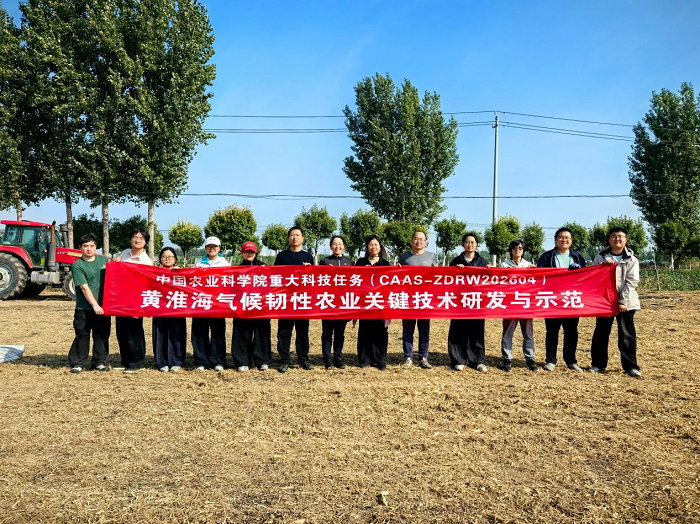
In mid-October, the CAAS Major Scientific and Technological Project "Development and Demonstration of Key Technologies for Climate-Resilient Agriculture across the Huang-Huai-Hai Plain", led by the Institute of Environment and Sustainable Development in Agriculture (IEDA), launched winter wheat sowing at the Xinxiang Comprehensive Experimental Base in Henan Province. Following its counterpart in Tai'an, Shandong Province, the Xinxiang demonstration zone represents another key step taken by the project team in the wheat-maize rotation region of the Huang-Huai-Hai Plain, marking the full-scale rollout of the project from the validation and demonstration of climate-resilient agricultural technologies.
Why Xinxiang: Targeting the most typical multi-hazard region in the Huang-Huai-Hai Plain
The Huang-Huai-Hai Plain is China's core production area for wheat and maize, the country's two major staple crops. However, frequent climate events - such as heat stress, rapid drought-flood alternation, waterlogging induced by prolonged rainfall, and late spring frosts - have become the greatest uncertainty threatening stable grain production. Located on the southern margin of the Huang-Huai-Hai Plain, Xinxiang exhibits the typical climatic characteristics of "rapid drought-flood alternation and abrupt temperature changes", making it a crucial place for testing the practical applicability of climate-resilient technologies.
The project team is not targeting individual technologies, but rather a complete set of challenges: how to ensure that farmland can store water and tolerate stress prior to a disaster, mitigate losses during the disaster, and recover quickly after that. The Xinxiang base therefore shoulders three tasks - validating the synergistic effects of "resilient cultivation - resilient farmland - resilient products" three-in-one technologies, and developing replicable technical regulations on disaster prevention during the wheat growing season.
Overall layout: 3-5 core demonstration zones, with a holistic and coordinated approach
The winter wheat sowing in Xinxiang is part of the project team's network of 3 to 5 core demonstration zones nationwide. Each demonstration zone is established according to the principles of "unified planning, zone-based validation, and collaborative breakthroughs" to form a validation network in which engineering facilities and agronomic measures, individual technologies and integrated technologies are cross-referenced against each other.
Based on the existing foundation of high-standard farmland, the Xinxiang demonstration zone will combine facilities such as ecological ditches, integrated irrigation and drainage systems, and integrated water and fertilizer equipment, with technologies including stress-tolerant varieties, soil improvement, agronomic regulation, and emergency response. The aim is to explore pathways of building resilient farmland that combines engineering and agronomic practices. The demonstration zone features two types of experimental fields: first, individual technology validation fields, which are used to evaluate the separate contributions of individual technologies by adjusting the combinations of these technologies; second, full-chain integration demonstration fields, which integrate technologies in five dimensions - early earning, variety, farmland, products and emergency response - to directly test how they will play together.
From technology R&D to field validation
This major scientific and technological project is coordinated by CAAS and led by IEDA, focusing on the Huang-Huai-Hai Plain, China's core grain production region. The wheat sowing in Xinxiang marks a crucial step in the project's evolution from single-season to year-round management, and from technology assembly to field validation.
Next, the project team will continue to conduct technology validation and model optimization across different ecological zones in the Huang-Huai-Hai Plain, advance the development of standardized technical regulations, and promote the implementation and extension of mature, applicable technologies. This will help build up a comprehensive climate-resilient agricultural technology system spanning pre-disaster early warning, in-disaster prevention and control, and post-disaster recovery.
