Recently, the Team of Plant Environmental Engineering of Protected Agriculture at the Institute of Environment and Sustainable Development in Agriculture, Chinese Academy of Agricultural Sciences, in collaboration with Tarim University in Xinjiang Uygur Autonomous Region, revealed the impacts of dust deposition on greenhouse films, spanning from microscopic deposition mechanisms to macroscopic crop physiological damage. The study aimed to address the challenges to protected agriculture in arid, wind-blown sand areas of southern Xinjiang, including intense dust deposition, optical distortion and significant yield losses. The related findings have been published in Agriculture.
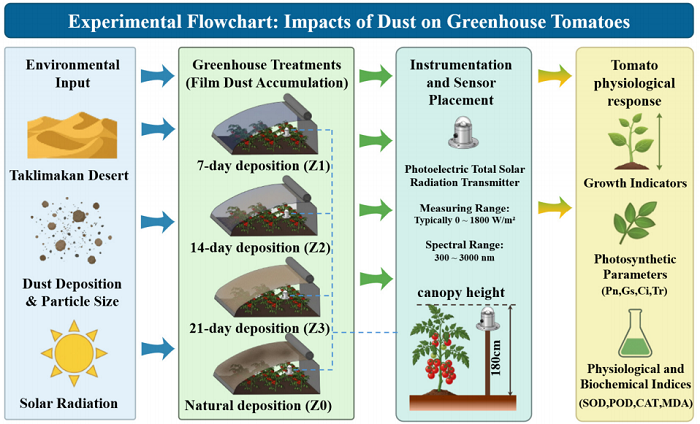
Figure 1. Flowchart illustrating the impacts of dust deposition on greenhouse tomato growth
Through the Computational Fluid Dynamics-Discrete Phase Model (CFD-DPM), the research team accurately simulated the transport trajectories of wind-sand flow around greenhouses. The study revealed pronounced spatial heterogeneity in dust distribution on the surface of greenhouse films due to the obstruction effect of greenhouse geometry, with dust primarily concentrated at the base of the windward slope and in the vortex region of the leeward slope. In contrast, the study showed relatively less dust deposition at the ridge of greenhouses due to the scouring effect of airflow. Further research revealed a "particle aerodynamic sorting" effect: driven by airflow, fine particles smaller than 65 μm are more likely to adhere to film surfaces, which is a key factor driving a sharp decline in light transmittance.
A test indicated that dust deposition significantly reduced daily light integral inside greenhouses, thereby inhibiting the plant height and net photosynthetic rate of crops such as tomatoes. The antioxidant enzyme activity exhibited an increase followed by a decline, reflecting photosynthetic constraints and oxidative stress. With regular dust removal, the data showed that maintaining a high-frequency removal interval of 7 to 14 days can effectively keep the light transmittance of greenhouse films above 70%. This provides a scientific management solution for protected tomato cultivation in desert areas.
This work was supported by the National Key Research and Development Program of China, the Central Guidance for Local Science and Technology Development Fund, the Belt and Road Initiative, and the Key Research and Development Program of Xinjiang Uygur Autonomous Region.
Linkage: https://doi.org/10.3390/agriculture16060660
