Recently, the Innovation Team of Novel Water-saving Materials and Agricultural Film Pollution Control at the Institute of Environment and Sustainable Development in Agriculture, Chinese Academy of Agricultural Sciences, has made new progress in weather resistance evaluation and service life prediction of biodegradable mulching films (BDMs). The related findings have been published in the Chemical Engineering Journal.
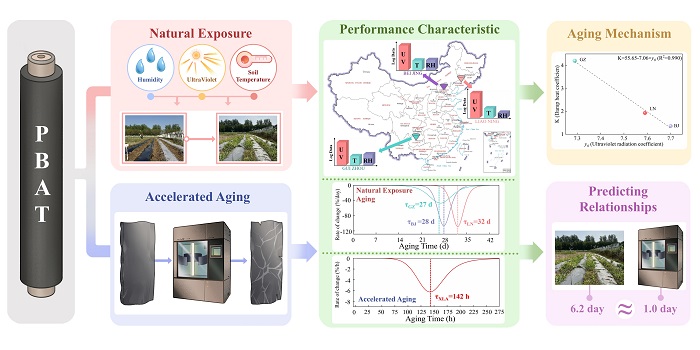
BDMs have emerged as alternatives to traditional mulching films owing to their ability to reduce "white pollution" in farmland; however, their widespread adoption is still limited by factors such as the uncertainty of their weather resistance and the difficulty in accurately predicting their service life across climates.
The research team conducted natural exposure tests in three typical climatic regions - Beijing, Guizhou and Liaoning - and xenon-lamp accelerated aging tests in the laboratory. The results indicate that the rate of "aging" of BDMs varies under different climatic conditions, and that temperature, humidity and ultraviolet radiation collectively determine the service life of BDMs in farmland. Therefore, the team built a comprehensive climate index to assess the degree of BDMs aging, identified the critical threshold for rapid BDMs performance aging, and established a time equivalent ratio of 1:6.2 between laboratory aging and natural exposure aging. This research preliminarily quantified the service life of BDMs in farmland, which can provide a theoretical basis for the design, R&D and scientific application of green materials to support the development of climate-resilient agriculture.
This work was supported by the National Key Research and Development Program of China, the National Natural Science Foundation of China, and the Agricultural Science and Technology Innovation Program (ASTIP) of the Chinese Academy of Agricultural Sciences.
Linkage: https://doi.org/10.1016/j.cej.2026.178285
