A recent study by the Team of Smart Meteorology and Utilization of Agro-climate Resources at the Institute of Environment and Sustainable Development in Agriculture, Chinese Academy of Agricultural Sciences, in collaboration with the Southern University of Science and Technology, proposed an innovative new approach no-regret decision-making based on Regret Theory to cope with "black swan" climatic disastrous events, the research findings have been published in Chinese Science Bulletin.
As global warming intensifies, extreme weather and climate events are becoming increasingly frequent. During the "7·20" torrential rainstorm in 2021 in Zhengzhou, the total precipitation at the Zhengzhou station hit 902 mm, more than twice of the historical maximum record and six times of the historical mean, and the dayly precipitation reached 624.1 mm, 3.4 times of the historical maximum observation. The rainstorm resulted in significant casualties and property losses with 398 dead or missing. The extreme rainstorms hitting the Beijing-Tianjin-Hebei region in 2023 brought the heaviest rainfall breaking the 140-year historical records, with accumulated precipitation at a particular location exceeding 744.8 mm. The occurrence of these extreme climatic disasters had been beyond the current horizon of scientific knowledge, posing severe challenges to disaster prevention and response decision-making.
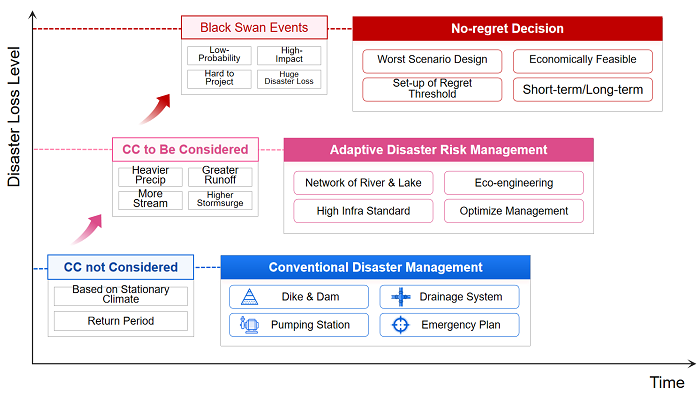
Based on the Regret Theory, this study outlined the basic principles and developed a systematic framework of "no-regret decision-making" for managing the low-probability but high-impact "black swan" climatic events. The core of "no-regret decision-making" is constructing a range of reasonable "worst-case" disaster scenarios, setting an acceptable "regret threshold" according to economic and social development levels and public psychological expectations, and on this basis optimizing response strategies. The study provided a conceptual insight into decision-making on "black swan" events.
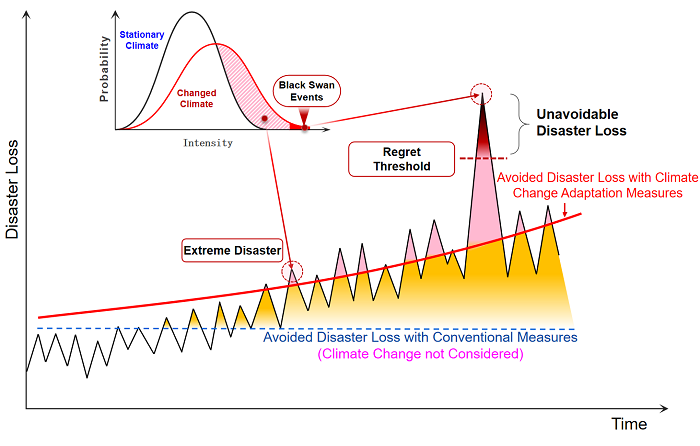
The procedural scheme of "no-regret decision-making" comprises the following three essential steps (Fig.2):
(1) Scientifically detect the signals of "black swan" climatic events. (2) Set a reasonable "regret threshold". (3) Enhance short-term emergency responses and improve long-term disaster reduction mechanisms.
This work was supported by China's National Key R&D Program projeect(2023YFF0805900), the Agricultural Science and Technology Innovation Program (ASTIP), and the Central Public-interest Scientific Institution Basal Research Fund.
Linkage: https://doi.org/10.1360/TB-2025-0150
