Recently, the Innovation Team of Plant Environmental Engineering of Protected Agriculture at the Institute of Environment and Sustainable Development in Agriculture, Chinese Academy of Agricultural Sciences, conducted an in-depth analysis of the regulatory patterns by which leaf age modulates dynamic photosynthesis and photoprotection characteristics in plants. The related findings have been published in the Plant Journal.
In both natural and greenhouse environments, plant leaves are frequently subjected to dynamic fluctuations in light. Furthermore, the heterogeneity of light and temperature within the canopy leads to significant variations in the photosynthetic characteristics of the leaves. However, because leaf age and environmental factors are highly intertwined, a key question remains unclear: Does leaf age itself directly regulate the dynamic photosynthesis and photoprotection mechanisms of leaves?
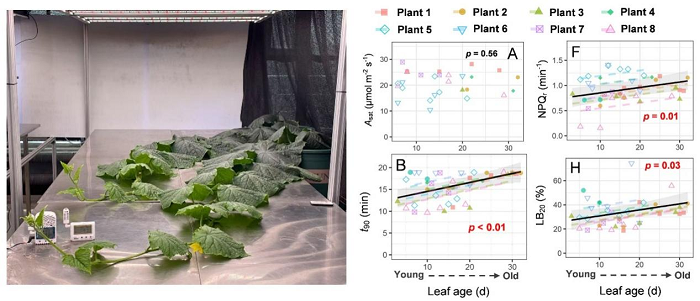
Using cucumbers as the study subject, a horizontal cultivation experimental design was adopted to eliminate the interference of mutual leaf shading. This approach systematically elucidated the regulatory patterns by which leaf age modulates the dynamic photosynthetic characteristics of plants. The results show that leaf age has a negligible effect on leaf photosynthetic potential. However, leaf senescence significantly delays the rates of photosynthetic induction and stomatal regulation under fluctuating light, reduces the leaf's light use efficiency under such conditions, and imposes stronger biochemical limitations during the early stages of photosynthetic induction. Furthermore, following a sudden drop in light intensity, senescent leaves exhibit an accelerated relaxation rate of non-photochemical quenching (NPQ). This study reveals that under stereo cultivation conditions in controlled environments, the decline in photosynthetic potential of lower leaves is primarily attributed to the low-light environment rather than leaf age progression. Activating these lower leaves through strategies such as inter-plant supplemental lighting can effectively tap into their photosynthetic potential and enhance whole-plant productivity.
This study was supported by the Central Public-interest Scientific Institution Basal Research Fund.
Linkage: https://onlinelibrary.wiley.com/doi/10.1111/tpj.71053
