Recently, the Innovation Team of Novel Water-saving Materials and Agricultural Film Pollution Control at the Institute of Environmental and Sustainable Development in Agriculture, Chinese Academy of Agricultural Sciences (CAAS), in collaboration with the Innovation Team of Saline-alkali Soils Amelioration at the Institute of Agricultural Resources and Regional Planning, CAAS, investigated the characteristics of the response of organic carbon storage and stability in saline soils in Hetao Irrigation District to straw interlayers at different application rates. The study revealed the regulatory mechanism by which soil pore structure and microbial r/K life strategy drive the conversion of humic fractions. The related findings have been published in Journal of Environmental Management.
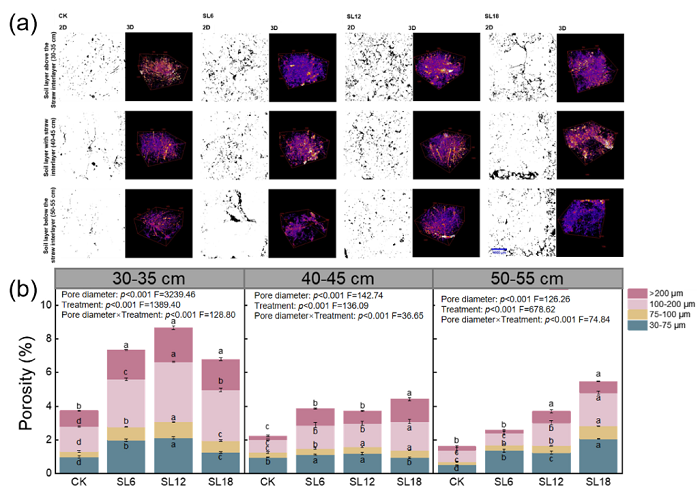
Effectively enhancing the potential of saline soils for organic carbon sequestration has become a critical issue that urgently needs to be addressed for the sustainable development of agriculture globally. While straw interlayer burial has demonstrated efficiency in saline soil amelioration, the mechanism by which it drives humus formation and stability in soil profiles remains unclear. Based on a four-year field experiment, the study systematically analyzed the hierarchical regulatory effects of straw interlayers at different application rates (0, 6, 12, 18 Mg ha-1) on soil pore structure, microbial r/K strategy succession and humic fractions.
The results show that the buried straw interlayer (with an application rate of 12 Mg ha⁻¹) significantly increased >200 μm macro-porosity above the interlayer (at 30-55 cm soil depths), stimulated r-strategy bacteria, and accelerated the conversion of lignin into fulvic acid and humin; within the interlayer (at 40-45 cm soil depths), it effectively promoted the growth of K-strategy bacteria, driving the polymerization of lignocellulose into humic precursors; and below the interlayer (at 50-55 cm soil depths), it further promoted the proliferation of K-strategy bacteria by reducing salinity, thereby increasing the carbon content of humic and fulvic acids. Overall, the 12 Mg ha⁻¹ treatment significantly increased organic carbon content at 40-55 cm soil depths by 25%–34%. The study provides theoretical support for the improvement of cultivated land quality and the realization of carbon neutrality in China's saline-alkali regions.
This study was supported by the National Natural Science Foundation of China (No. U23A2054, 31871584), the Central Public-interest Scientific Institution Basal Research Fund (No. BSRF202601), and the Agricultural Science and Technology Innovation Program of CAAS (ASTIP No. CAAS-ZDRW202407).
Linkage: https://doi.org/10.1016/j.jenvman.2025.128297
