Recently, the Innovation Team of Clean Conversion and High-value Utilization of Farming Waste at the Institute of Environment and Sustainable Development in Agriculture, Chinese Academy of Agricultural Sciences, proposed a theoretical framework for hydrothermal humification targeting the carbon cycle in agricultural ecosystems. The related findings have been published in Advanced Science.
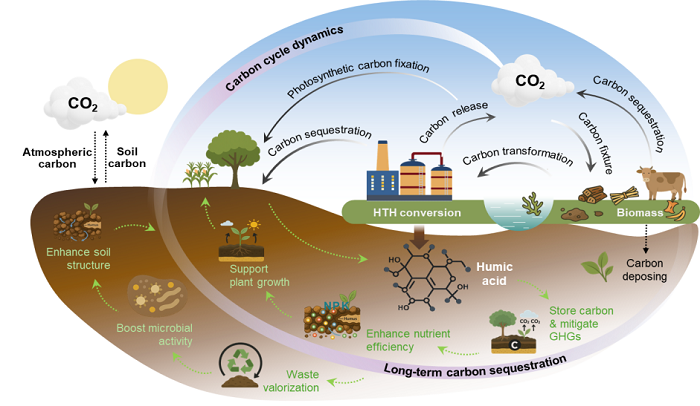
Humic substances form the foundation for improving soil fertility, enhancing soil structure, and increasing agricultural carbon sequestration. To address the challenges of the slow and inefficient natural humification of agricultural waste, hydrothermal humification technology simulates the natural humification process under subcritical conditions, enabling the conversion of agricultural waste into hydrothermal humic acid and fulvic acid within hours.
This study systematically reveals the intrinsic linkages among biomass component transformation, humic acid structural regulation, soil function enhancement, and carbon mitigation benefits during hydrothermal humification. By modulating reaction pathways such as hydrolysis, condensation, and oxidation, the yield, structural stability, and functional bioactivity of hydrothermal humic acid can be significantly enhanced. The resulting humic acid improves soil organic matter content, nutrient retention capacity, and aggregate structure, while also promoting plant growth and pollutant immobilization. This approach provides a novel pathway for the high-value conversion of agricultural wastes, the enhancement of soil carbon sequestration, and the development of negative-emission agricultural technologies.
This study was supported by the Agricultural Science and Technology Innovation Program (ASTIP) of the Chinese Academy of Agricultural Sciences and the National Key Research and Development Program of China.
Linkage:https://advanced.onlinelibrary.wiley.com/doi/10.1002/advs.75558
