Recently, the Innovation Team of Smart Meteorology and Utilization of Agro-climate Resources at the Institute of Environment and Sustainable Development in Agriculture, Chinese Academy of Agricultural Sciences, conducted a greenhouse pot experiment to explore the regulating effects of microalgae biofertilizer on greenhouse gas (GHG) emissions from paddy soil. The study revealed that microalgae biofertilizer reduces methane emissions associated with lower dissolved organic carbon concentration and mcrA gene abundance in paddy soil. The related findings have been published in Chemical and Biological Technologies in Agriculture.
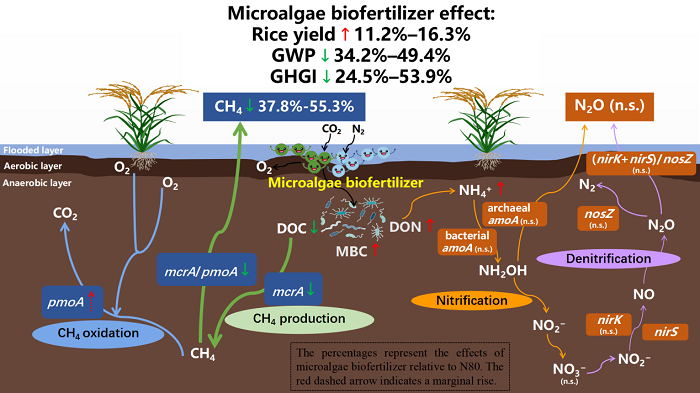
Novel fertilizer products are pivotal for boosting rice yields while cutting GHG emissions from paddy fields. Microalgae biofertilizer offers great potential for enhancing soil fertility and crop productivity. However, few studies have addressed its effects on GHG emissions from paddy soil and the underlying mechanisms.
Through a greenhouse pot experiment, the study revealed that 20% reduced nitrogen fertilizer plus microalgae biofertilizer cut CH4 emissions from rice paddies notably, but had no significant effect on N2O emissions. The notable reduction in CH4 emissions was associated with the reductions of soil dissolved organic carbon concentration, mcrA gene abundance, and mcrA/pmoA ratio. 20% reduced nitrogen fertilizer plus microalgae biofertilizer can significantly reduce the comprehensive warming potential and GHG emission intensity in paddy soil, while boosting rice yields. These findings provide crucial experimental data to support the development of microalgae biofertilizer technology that reduces methane emissions while maintaining stable rice yields.
This work was supported by the Agricultural Science and Technology Innovation Program (ASTIP) and the National Natural Science Foundation of China (NSFC).
Linkage: https://doi.org/10.1186/s40538-026-00996-y
