Recently, the Innovation Team of Smart Meteorology and Utilization of Agro-climate Resources at the Institute of Environment and Sustainable Development in Agriculture, Chinese Academy of Agricultural Sciences (CAAS), conducted a study on changes in soil carbon stocks based on a free-air CO2 enrichment (FACE) platform. The study revealed that elevated CO2 significantly reduced labile soil organic carbon (SOC) factions. The related findings have been published in Agriculture, Ecosystems & Environment.
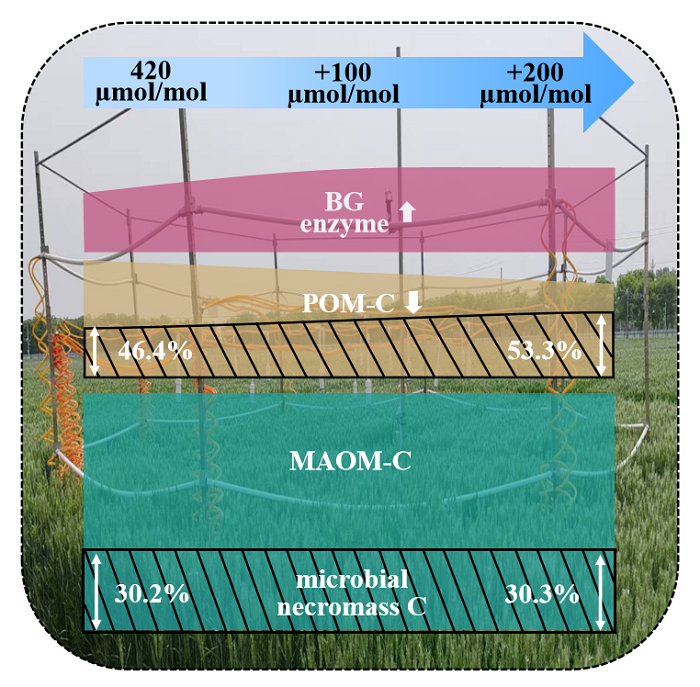
Figure: Conceptual diagram of the dynamics of SOC fractions under different CO2 concentrations
Fractionation is fundamental to in-depth research on soil carbon dynamics and the development of climate change strategies and agricultural management measures. The effects of elevated atmospheric CO2 on different soil carbon fractions and its microbial-driven mechanisms remain unclear.
By sampling at key crop growth stages, the study addressed the limitation of single-time-point sampling, which fails to capture the seasonal dynamics of soil carbon pools. It revealed that three-year continuous elevation of CO2 concentrations significantly reduced particulate organic carbon (POM-C) but had no effect on mineral-associated organic carbon (MAOM-C). The study also quantified microbial necromass contributions across different carbon fractions, and identified a growth stage dependence of such contributions. This provides important baseline data for understanding how cropland soil carbon sequestration responds to future climate change, and contributes to the improvement of terrestrial carbon-climate feedback prediction models.
This work was supported by the CAAS Center for Science in Agricultural Green and Low Carbon.
Linkage: https://doi.org/10.1016/j.agee.2026.110461
