Recently, the Agricultural Emerging Contaminants and Environmental Health Risk Prevention and Control Team discovered that electrochemical disinfection (EC) coupled with antibiotic stress can promote the development of antibiotic–electrochemical cross-resistance in disinfection residual bacteria (DRB). Through long-term stress exposure experiments, the team experimentally validated the evolutionary emergence of such cross-resistance and further elucidated the associated cellular physiological and metabolic characteristics of DRB during the stress response. These findings have been published in Environment International.
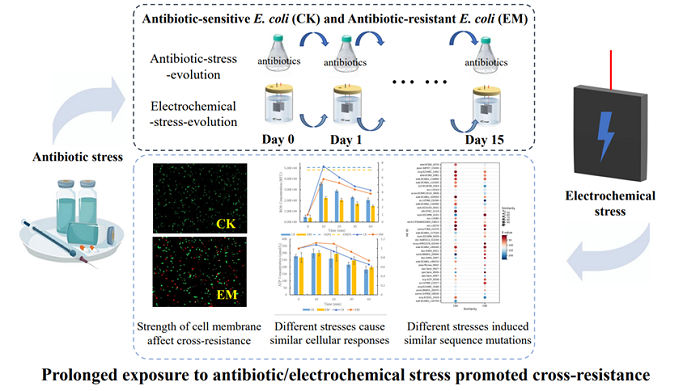
The effective control of antibiotic resistance in advanced water and wastewater treatment has emerged as a critical global concern. Disinfection residual bacteria (DRB) are frequently associated with antibiotic resistance, and their cross-resistance to various disinfectants (or disinfection methods) and antibiotics complicates the potential risks following disinfection. Our prior work demonstrated the pivotal roles of specific antibiotic resistance gene (ARG) subtypes and epigenetic phenotypes in mediating electrochemical–antibiotic cross-resistance. Building upon these findings, the present study employed multidrug-resistant Escherichia coli to further investigate the cellular response mechanisms and evolutionary dynamics of cross-resistance in DRB under combined electrochemical oxidation and antibiotic stress.
Our results indicated that, compared to antibiotic-susceptible E. coli, antibiotic-resistant strains exhibit lower metabolic activity and enhanced cell membrane integrity, which collectively contribute to cross-resistance. Continuous co-exposure to antibiotics and electrochemical stress accelerated the evolution of cross-resistance in initially susceptible strains. Specifically, the electrochemical inactivation efficiency declined from 0.96 to 0.63 within five days, while concomitant antibiotic resistance rapidly evolved, reaching a level comparable to that of the resistant strain within nine days. This confirms that sustained stress can drive the rapid development of non-genetic resistance phenotypes in E. coli over a short timeframe. Further genomic and functional analyses revealed that both antibiotic and electrochemical stresses induced convergent mutations in genes associated with cell division, stress response, biofilm formation, and transport systems.
This study systematically evaluated the evolutionary trajectory of bacterial cross-resistance and provides mechanistic insights into resistance development during electrochemical disinfection. By integrating the potential for DRB to evolve cross-resistance, these findings offered a more comprehensive framework for assessing the true efficacy and safety of disinfection processes.
This work was supported by the National Key Research and Development Program and Agricultural Science and Technology Innovation Program of China, and Central Public-interest Scientific Institution Basal Research Fund.
The original article is available at: https://www.sciencedirect.com/science/article/pii/S0160412025007536
