Recently, the Innovation Team of Smart Meteorology and Utilization of Agro-climate Resources at the Institute of Environment and Sustainable Development in Agriculture, Chinese Academy of Agricultural Sciences, proposed a plasticity-aware genomic selection (PA-GS) framework, which enhances cross-environment prediction. It also provides a novel approach that reduces investment in field trials while optimizing the allocation of breeding resources. The related findings have been published in Computers and Electronics in Agriculture.
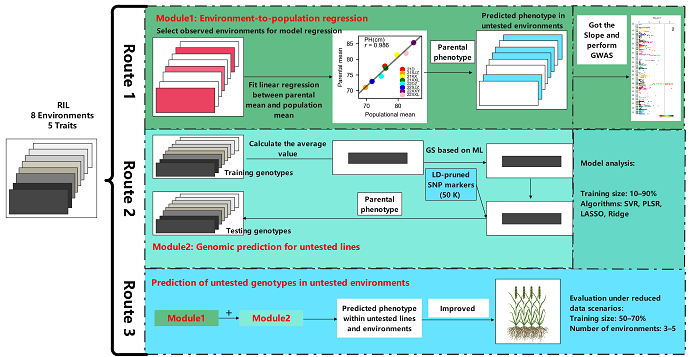
Workflow of the new prediction framework modules
Traditional cross-environment variety trials must be conducted across multiple locations and years. While these trials can assess the adaptability of breeding materials, they are time-consuming and costly.
Using a recombinant inbred line wheat population, the research team assessed grain yield, thousand-kernel weight, kernel number per spike, spike number, and plant height across eight environments. The research found that with phenotypic data from only 50% of genotypes assessed in three environments, the framework achieved prediction accuracies of 0.70 for plant height, 0.54 for kernel number per spike, and 0.59 for thousand-kernel weight, indicating its potential for reducing the scale of trials. This framework quantified wheat response to environmental changes as plasticity traits, enabling cross-environment prediction without the need for complex environmental descriptors. It can provide digital decision support for experimental design and parent selection.
This work was funded by the National Key Research and Development Program of China, and the National Natural Science Foundation of China.
Linkage: https://doi.org/10.1016/j.compag.2025.111371
