Recently, the Agricultural Emerging Contaminants and Environmental Health Risk Prevention and Control Team at the Institute of Environment and Sustainable Development in Agriculture, Chinese Academy of Agricultural Sciences, developed a deep machine-learning model for multi-objective optimization of animal manure composting, termed EcoCompost. The model elucidates the key driving mechanisms and nonlinear relationships governing nutrient dynamics and the transformation of toxic substances during composting, thereby providing a scientifically grounded and precision-oriented technical strategy for the safe, efficient, and high-quality valorization of organic wastes. The findings have been published in Bioresource Technology.
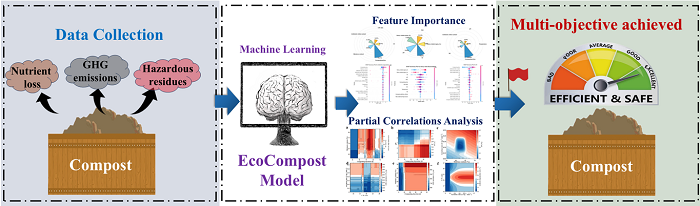
Aerobic composting of animal manure is an important pathway for the resource utilization of agricultural wastes. However, conventional composting processes often face major bottlenecks, including substantial carbon and nitrogen losses, high emissions of greenhouse gases and ammonia, and the insufficient removal of harmful residues such as antibiotics and heavy metals. Therefore, developing predictive and optimization models capable of coordinating multiple objectives through process-parameter regulation is crucial for achieving green, low-carbon emission reduction. The study demonstrated that EcoCompost, constructed based on a multilayer feedforward neural network, can simultaneously predict nutrient losses, greenhouse gas emissions, antibiotic degradation, and heavy-metal immobilization with high accuracy. The research further identified the priority target drivers for each indicator: the initial carbon-to-nitrogen ratio (C/N) was found to be the core driver of carbon and nitrogen nutrient losses, whereas composting duration and total phosphorus content were closely associated with antibiotic degradation and heavy-metal immobilization. Subsequent validation experiments showed that the optimal parameter combination recommended by the model—incorporating appropriate aeration rate, initial moisture content, and C/N ratio—significantly reduced carbon loss and ammonia emissions, decreased the bioavailability of heavy metals, and substantially enhanced the humification degree and stability of the final compost product.
This study not only deepens our understanding of the intrinsic mechanisms underlying complex nonlinear composting systems, but also offers a new multi-objective optimization framework for the efficient, green, and safe treatment of livestock manure.
This study was supported by the National Key Research and Development Program and Agricultural Science and Technology Innovation Program of China.
The original article is available at: https://doi.org/10.1016/j.biortech.2026.135003
