Recently, the Remediation of Degraded and Contaminated Farmland Team from the Institute of Environment and Sustainable Development in Agriculture, Chinese Academy of Agricultural Sciences, has made new progress in revealing a novel mechanism by which the iron plaque-biofilm composite on rice roots reduces arsenic uptake. The related findings have been published in the New Phytologist.
While the iron plaque on rice roots can inhibit arsenic uptake and serves as a key interface for the colonization and metabolism of rhizosphere microorganisms, arsenic pollution stress suppresses the formation of the "iron plaque-biofilm" composite structure and compromises its barrier function. A major scientific challenge lies in harnessing arsenic-resistant plant growth-promoting microbes to reinforce this composite barrier, thereby achieving the dual goals of reducing arsenic uptake and promoting rice growth.
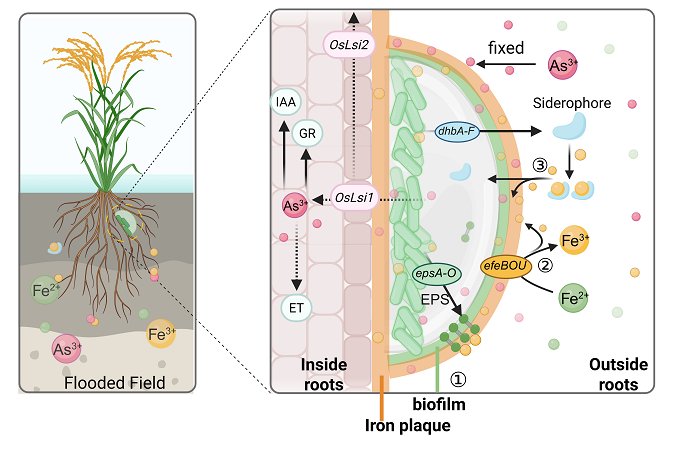
This research successfully engineered an arsenic-resistant plant growth-promoting rhizobacterium, Bacillus subtilis p43-Taglo1, that efficiently expresses the arsenic-binding protein Taglo1. Under arsenic-contaminated conditions, this strain can efficiently colonize rice roots and fortify the natural iron plaque-biofilm barrier, thereby achieving the dual objectives of reducing arsenic uptake and increasing yields. The research findings indicate that the strain directly or indirectly promotes iron plaque formation on rice roots by increasing iron oxidation, siderophore secretion, and extracellular polymeric substance production, thereby achieving efficient arsenic immobilization. Further research revealed that the expression of the arsenic-resistant gene Taglo1 triggered a cascade response in key genes within the microorganism-rice system. This ultimately resulted in an enhanced root barrier, reduced arsenic uptake, and increased rice yields. This research proposes a novel remediation strategy based on the synergistic enhancement of the iron plaque-biofilm composite on rice roots, providing both a theoretical basis and a technical pathway for the safe production and green remediation of arsenic-contaminated paddy fields.
This research was funded by the National Natural Science Foundation of China and the Agricultural Science and Technology Innovation Program of the Chinese Academy of Agricultural Sciences.
Linkage: https://doi.org/10.1111/nph.71255