Recently, the Team of Agro-meteorological Disaster Prevention and Control at the Institute of Environment and Sustainable Development in Agriculture, Chinese Academy of Agricultural Sciences (CAAS), revealed a combined lead (Pb) and cadmium (Cd) risk pattern in karst croplands under intensive agriculture, providing a scientific basis for preventing agro-environmental disaster risks and advancing the development of resilient croplands. The related findings have been published in Catena.
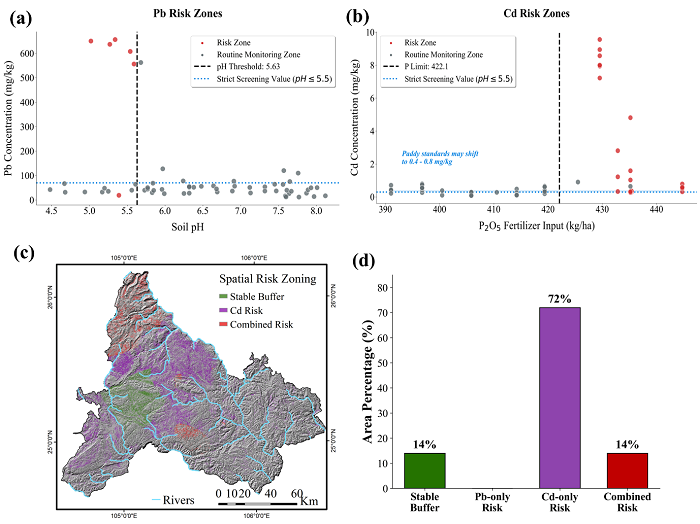
Karst regions possess thin soil profiles with limited buffering capacity, where heavy metal accumulation is threatening cropland health. Yet, there is still a lack of systematic understanding regarding how anthropogenic nutrient inputs and water and soil conditions jointly affect the distribution of heavy metals, restricting the precise identification and zoned control of environmental risks.
Integrating soil measurement, remote sensing, meteorological and agricultural input data with interpretable machine learning, the research team revealed higher predictive contributions of anthropogenic nutrient inputs and relevant environmental factors than those of direct topographic variables. The study identified exploratory breakpoints for soil pH and nitrogen and phosphorus inputs, and found that Pb-risk areas are nested within the broader Cd-risk areas, resulting in a pattern of "widespread Cd risks coupled with localized combined Pb and Cd risks". Based on these findings, the research team proposed a breakpoint-based risk zoning framework, providing new insights into precision risk control in karst croplands.
This work was supported by the National Key Research and Development Program of China, the National Natural Science Foundation of China, and the CAAS Major R&D Program.
Linkage: https://doi.org/10.1016/j.catena.2026.110584
